Choosing the wrong centrifugal fan costs more than money. It costs airflow, energy, and uptime. A fan picked from a nameplate CFM figure alone will almost certainly underperform once it meets real duct resistance, filters, and coils. This guide walks through the engineering method professionals use to select centrifugal fans—from defining a duty point to verifying performance at the installed operating condition.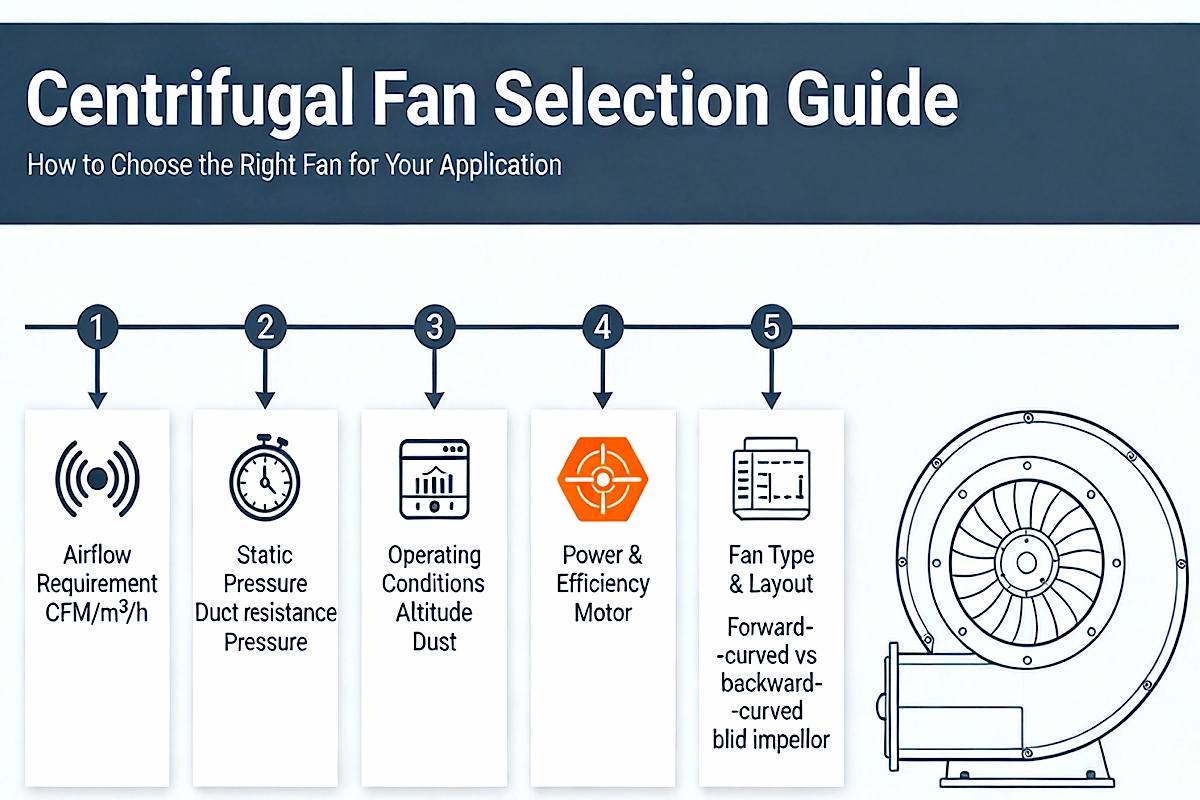
A centrifugal fan moves air radially: air enters axially through the impeller center and is accelerated outward at roughly 90 degrees, then converted into static pressure by the scroll-shaped housing. That design produces higher static pressure than axial fans, making centrifugal fans the right choice whenever the air path includes filters, coils, long duct runs, or other resistance.
If your system has significant pressure losses, centrifugal fans outperform axial alternatives. If you only need high airflow with minimal resistance, an axial fan may be more efficient and compact. The decision comes down to system resistance, not habit.
The most common selection mistake is choosing a fan based on its rated maximum airflow. A catalog may list “1,000 CFM,” but that number means little until it is paired with pressure, air density, installation boundary, and the resistance of the connected equipment.
Maximum airflow is measured near free delivery, where external pressure is close to zero. Real systems are never at zero pressure. A duty point is the pair of numbers your system actually needs at design conditions: airflow (CFM or m³/h) and the static pressure the fan must overcome (Pa or in. wg).
A fan rated at 11,000 m³/h and 910 Pa does not deliver 11,000 m³/h against 910 Pa. At 8,000 m³/h, it may have only 680 Pa available—and that is the number that determines whether your system works.
If your application has multiple operating modes—clean vs. loaded filters, summer vs. winter air density, minimum vs. maximum speed—list each one as a separate duty point. Each will land on a different operating point on the same fan curve.
The fan is only one part of the air path. Before you evaluate any candidate, estimate or measure the pressure loss of every relevant component at the required airflow: inlet screen, duct length, bends, transitions, filter, coil, outlet, damper, and downstream equipment.
This step is where many selections fail. A fan that looks acceptable at a clean operating point may run out of reserve when filter resistance increases. Another may be so oversized that it spends its life throttled, noisy, or unstable at low command.
Size the pressure budget for the dirty-filter condition, not the clean one. Margin should answer named uncertainty—not hide missing data.
Centrifugal fans come in three primary blade designs, each suited to different pressure and airflow requirements.
| Impeller Type | Airflow | Static Pressure | Efficiency | Best For |
|---|---|---|---|---|
| Forward Curved (FC) | High | Low to medium | 65–70% | Fan coil units, compact HVAC, residential ventilation |
| Backward Curved (BC) | Medium | Medium to high | 75–85% | Commercial AHUs, long duct systems, dust filtration |
| Radial | Medium | High | 72–79% | Dust-laden air, industrial exhaust, high-temperature processes |
Forward curved fans deliver high volume at low pressure and are compact, but they become noisier as pressure rises and are prone to overloading the drive motor. Backward curved fans offer higher efficiency, lower noise, and a stable pressure-flow relationship across a broad operating range—making them the standard choice for commercial and industrial HVAC systems. Radial fans handle the toughest conditions: dust, moisture, and corrosive gases, where efficiency takes a back seat to durability.
For most modern commercial AHU and data center applications, backward curved fans—especially EC types—are the preferred choice due to efficiency, reliability, and quieter operation.
A fan performance curve is a map, not a promise. The connected system chooses one address on that map.
Three curves describe a fan’s behavior: the static pressure curve, the brake horsepower curve, and the efficiency curve. The installed operating point is where the fan’s pressure curve intersects the system resistance curve—the rising line that represents ducts, fittings, filters, coils, and grilles.
At that intersection, read every performance layer: pressure, absorbed power, efficiency, sound, and operating limits. Confirm that the pressure curve reaches the required value. Check efficiency at the actual operating point rather than relying on a headline peak. Verify that the operating point does not fall in an unstable region or require heavy throttling.
The physically largest fan is not automatically the best selection. A candidate that crosses the duty point only near an unstable region needs additional review or rejection.
The comfort band for fan selection margin is 10–25% above the required pressure at the duty point: enough to keep airflow when filters load up, not so much that the fan runs far below its efficient range. Below about 8% margin, the system will struggle as resistance increases. Above 25%, you are paying for capacity you will never use—and likely running at a poor efficiency point.
Margin should be applied to pressure, not airflow alone. Over-sizing airflow without matching pressure simply moves the operating point along the curve to a less efficient region.
Air density changes everything. Temperature, altitude, humidity, and gas composition shift the pressure a fan produces, the power it draws, and the motor loading. Fan curves are published at standard air (20 °C, 101.3 kPa, 1.2 kg/m³). At altitude or in hot exhaust streams, correct the required pressure first.
Air power is airflow multiplied by pressure, but electrical input is higher because the fan, motor, electronics, and drive are not perfectly efficient. Ask which power boundary the curve uses: shaft power, motor input, or complete electrical input. A maximum input rating is not the same as duty-point input power.
If a variable-speed fan is planned, confirm command range, feedback, current limit, thermal limit, and stable operation across both clean and loaded resistance cases.
Electronically commutated (EC) motors have become the preferred drive for centrifugal fans in HVAC, data centers, and cleanroom applications. Field measurements from retrofit projects show that replacing AC belt-driven centrifugal fans with EC direct-drive plug fans improved overall efficiency from 51% to 66% in an airport air handling unit, and from 10% to 42% in a hospital fresh air unit. In 24/7 operations, that difference compounds into substantial energy savings.
Backward curved centrifugal fans with EC motors can reduce energy consumption by up to 30–40% compared to conventional forward curved alternatives, particularly in continuous-duty systems such as air handling units and cleanroom ventilation.
EC motors also enable precise speed control, allowing the fan to match actual thermal load rather than running at full speed continuously. In data center cooling, this is one of the most direct methods for reducing PUE.
The EU’s Ecodesign regulation for fans (ErP 2026) raises minimum efficiency requirements from July 2026. Centrifugal fans with backward-curved blades must meet a minimum fan efficiency grade of 64%, while axial fans must reach 50%. Selecting an EC backward curved fan today is not just an efficiency choice—it is a compliance strategy for the coming decade.
The best solution to fan noise problems is selecting a quiet fan in the first place and mounting it properly to minimize noise transmission. Among centrifugal fan types, airfoil backward inclined blades are the quietest, followed by plain backward inclined blades. Radial blade fans are the noisiest.
Key noise reduction strategies at the selection stage include:
Choose backward-curved blades over forward-curved or straight blades—they produce less turbulence and lower tonal noise.
Keep tip speed as low as possible. Higher speed increases both tonal and broadband noise.
Operate near the best efficiency point. A fan running near its maximum efficiency is inherently quieter than one throttled to an inefficient operating point.
Use vibration isolation mounts and acoustic enclosures where noise limits are strict.
For air handling units and data center cooling, a fan array—multiple smaller fans operating in parallel—offers redundancy and serviceability advantages over a single large fan. If one fan fails, the others can increase speed to compensate, avoiding a single point of failure. A fan wall can also reduce the axial length of the AHU by up to 33%.
However, fan arrays are not universally better. Smaller fans are individually less efficient, and the lattice frame structure adds cost. A single large fan may be the better choice when planned shutdowns are acceptable and simpler electrical, control, and maintenance arrangements matter more. The decision depends on redundancy requirements, available space, and maintenance philosophy.
Always confirm that fan performance data is certified to ANSI/AMCA Standard 210 or ISO 5801. These standards establish uniform laboratory test methods for determining airflow rate, pressure developed, power, and efficiency. Performance data not tested to these standards may not reflect real installed behavior.
When comparing fans, ensure the curves use the same pressure definition (static vs. total), the same air density basis, and the same power boundary. Two charts that look similar may describe different measurement boundaries.
Define the duty point: required airflow plus static pressure at each operating condition.
Build the pressure budget: sum all component losses at the dirty-filter condition.
Select the impeller type: forward curved for high volume low pressure, backward curved for efficiency and higher pressure, radial for harsh industrial duty.
Read the fan curve: find the intersection of fan and system curves, then verify pressure, power, efficiency, and noise at that point.
Apply 10–25% pressure margin: enough for filter loading, not so much that the fan runs inefficiently.
Correct for air density: altitude, temperature, and gas composition all shift performance.
Check motor and control: confirm power boundary, speed range, and stable operation across all conditions.
Evaluate noise and installation: select backward-curved blades, low tip speed, and proper isolation.
Verify certification: AMCA 210 or ISO 5801 test data only.
A defensible centrifugal fan selection begins with a duty point, finds the intersection between fan and system curves, and reads every performance layer at that same airflow. Skipping any step invites a fan that underper