Ventilation is the lifeline of every underground mining operation. Without a properly designed and continuously maintained airflow system, toxic gases accumulate, temperatures rise to dangerous levels, and respirable dust concentrations become unmanageable. The two foundational parameters that govern any mine ventilation design are airflow volume (air quantity) and negative pressure (pressure differential or mine resistance) .
Understanding how to calculate these two parameters accurately is essential for ventilation engineers, mine planners, and safety officers. This guide explains the core calculation methods, key formulas, and practical considerations for determining airflow and negative pressure in underground mines.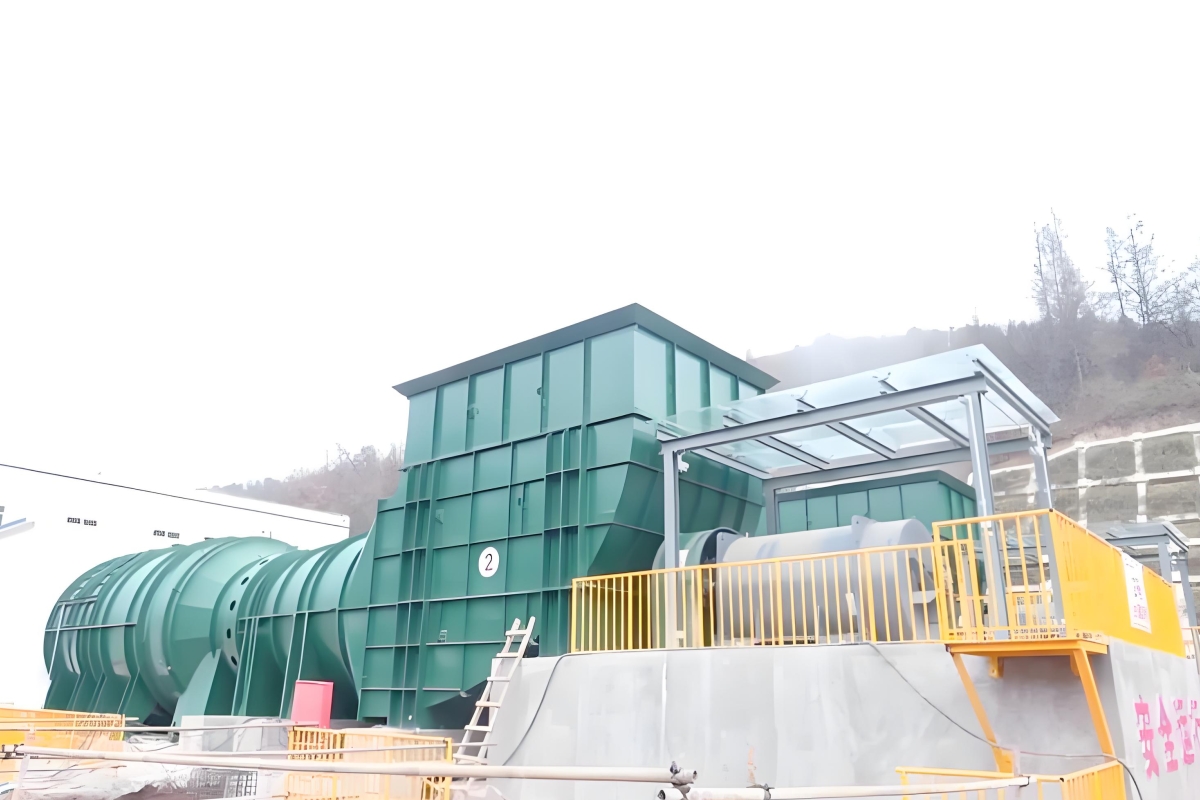
Mine ventilation airflow requirements cannot be determined by a single formula. Regulatory frameworks worldwide require that the required air quantity be calculated using multiple independent criteria, and the maximum value among them is adopted as the design airflow for each working area. These criteria typically include:
Airflow per person — The minimum volume of fresh air that must be supplied per worker.
Airflow per tonne of daily output — A production-based requirement.
Dilution of gases — Airflow needed to dilute methane, carbon monoxide, and other harmful gases to safe concentrations.
Dilution of blasting fumes — Airflow required to clear explosive fumes after blasting.
Dust control — Minimum air velocity to suppress and remove airborne dust.
Diesel equipment — Airflow required to dilute exhaust emissions from diesel-powered machinery.
Temperature control — Airflow needed to maintain acceptable thermal conditions.
1. Airflow by number of workers:
Where is the required airflow (m³/min), is the minimum air volume per person (typically 4 m³/min in Chinese regulations, or 0.1 m³/s per person in many international standards), and is the maximum number of workers in the district during the largest shift.
2. Airflow by gas emission (methane dilution):
Where is the required airflow (m³/min), is the absolute methane emission rate (m³/min), and is the ventilation coefficient (typically 1.5–2.0).
3. Airflow by minimum velocity (dust control):
Where is the minimum allowable air velocity (typically 0.15–0.25 m/s for dust removal in coal headings) and is the maximum cross-sectional area of the roadway (m²).
4. Airflow for diesel equipment:
Where is the airflow index per unit power of diesel equipment (m³/(kW·min)) and is the total rated power of diesel equipment operating simultaneously, adjusted by a time-utilization factor.
Different jurisdictions set different minimum requirements. For example:
Australia (New South Wales, coal mines): 10,000 ft³/min; 100 ft³/min per brake horsepower for locomotives.
India (coal mines, CMR 2017): Not less than 6 m³/min per person on the largest shift, or 2.5 m³/min per tonne of daily output, whichever is greater.
Canada (Ontario, metal/non-metal): 0.06 m³/s per kW of installed diesel power.
Chile: 3 m³/min per person with a maximum velocity of 150 m/min.
These standards illustrate that airflow calculation must always begin with the applicable regulatory framework for the specific mine type and jurisdiction.
The total mine airflow requirement is the sum of:
Airflow for each production face
Airflow for each development heading
Airflow for independent ventilation rooms and chambers
Air leakage allowance
The total ventilation requirement should account for leakage through stoppings, doors, and the fan station itself. The mine fan must deliver the required air quantity divided by the station leakage coefficient.
In mine ventilation, negative pressure (also called depression or pressure differential) refers to the pressure difference that must be created by the main fan to overcome the total resistance of the ventilation network. It represents the energy required to push air through all the airways from the intake to the return.
The fundamental equation governing pressure loss in mine airways is the Atkinson equation, first proposed in 1890 and still the standard tool for ventilation design:
Where:
= pressure loss (Pa)
= friction factor (Ns²/m⁴), expressing airway resistance to airflow
= perimeter of the airway (m)
= length of the airway (m)
= volumetric flow rate (m³/s)
= cross-sectional area of the airway (m²)
This equation reveals a critical principle: pressure loss increases with the square of airflow volume. A 20% increase in airflow produces approximately a 44% increase in pressure loss, all else being equal.
The total negative pressure required for a mine ventilation system is the sum of:
Where:
= total frictional resistance of all airways along the ventilation circuit
= local resistance (typically calculated as 15% of total frictional resistance)
= natural ventilation pressure (which may assist or oppose the mechanical fan)
In practice, the calculation for each airway segment follows:
Where is the friction resistance coefficient of the specific roadway type.
Natural ventilation pressure arises from the density difference between intake and return air columns, caused by temperature differences between the two shafts:
Where is atmospheric pressure, is mining depth, is the gas constant, and are the absolute temperatures on the intake and return sides, and is gravitational acceleration.
Natural ventilation can be significant — in one worked example, it contributed 571 Pa of assisting pressure, which was subtracted from the mechanical ventilation requirement.
Consider a mine with the following simplified conditions:
Total frictional resistance of the ventilation circuit: 1,005.90 Pa (easy ventilation period)
Total frictional resistance during the difficult ventilation period: 1,471.42 Pa
Natural ventilation pressure: 571 Pa (assisting)
The net negative pressure required from the main fan during the easy period would be:
During the difficult period (when natural ventilation may reverse or be insufficient):
The relationship between airflow and pressure loss defines the mine resistance curve:
This curve is plotted against the fan characteristic curve (provided by the manufacturer) to determine the operating point — the actual airflow and pressure at which the fan will operate. For a mine with resistance , a natural draft pressure of 0.28 inches water would produce an airflow of:
A complete ventilation design follows this sequence:
Determine required airflow at each working face using the multiple-criteria method (maximum of all calculated values)
Sum all airflow requirements including leakage allowances
Calculate pressure losses for every airway segment using the Atkinson equation
Account for local resistances (shock losses at bends, junctions, and regulators)
Adjust for natural ventilation pressure
Plot the mine resistance curve and intersect it with candidate fan curves
Select the fan that meets both the airflow and pressure requirements with adequate margin
Fan selection must account for several practical factors:
Airflow volume and static pressure demand — the fan must deliver the required quantity at the calculated system pressure.
Mine layout and resistance distribution — complex networks with multiple splits require careful network analysis.
Equipment activity and future expansion — the ventilation system must accommodate changing mining conditions.
Energy efficiency — ventilation can account for up to 40% of total electricity consumption in underground mines, making fan efficiency a major cost factor.
As airways lengthen — for example, in long-distance inclined shaft construction — the required fan airflow increases linearly while the corresponding ventilation negative pressure increases quadratically. This non-linear relationship means that fan power requirements escalate rapidly with distance, making accurate calculation essential.
While the Atkinson equation remains the foundation, modern mine ventilation design increasingly relies on network analysis software such as VentSim, VNet, and specialized simulation tools. These programs solve the complete ventilation network by simultaneously satisfying Kirchhoff's laws for airflow and pressure distribution. However, the underlying calculations always trace back to the same fundamental principles described in this article.
Accurate calculation of mine ventilation airflow and negative pressure is not merely a regulatory obligation — it is a safety-critical engineering practice. The airflow volume must be determined from multiple independent criteria and the maximum value adopted. The negative pressure must be calculated using the Atkinson equation across all airways, with proper adjustments for local resistances and natural ventilation effects.
When these two parameters are correctly established, they define the operating point that determines fan selection, energy consumption, and ultimately the safety of every worker underground. Whether you are designing a new mine or optimizing an existing ventilation system, mastering these calculation methods is the essential first step.
Key Takeaways:
Required airflow is the maximum of calculations based on personnel, gas emission, dust control, blasting fumes, diesel equipment, and temperature criteria.
Pressure loss follows the Atkinson equation: , meaning pressure grows with the square of airflow.
Total mine negative pressure = frictional resistance + local resistance ± natural ventilation pressure.
The mine resistance curve and fan characteristic curve intersect at the operating point that defines actual system performance.
Ventilation can consume up to 40% of a mine's electricity — accurate calculation directly reduces operational costs.