Product Introduction
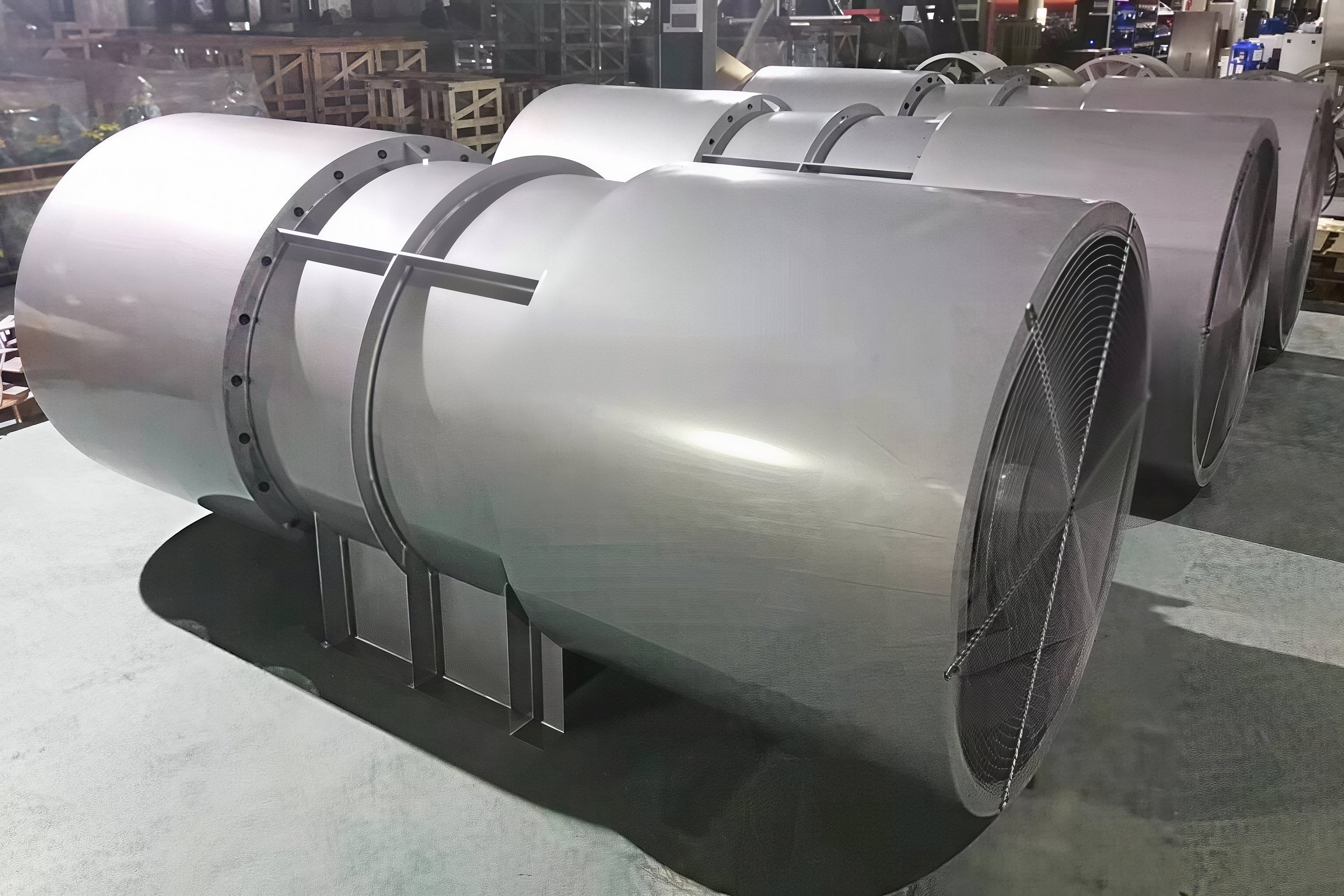
Bidirectional Reversible Tunnel Jet Fan
Bidirectional Reversible Tunnel Jet Fans are core components for longitudinal ventilation, specifically designed for tunnels with two-way traffic and emergency smoke extraction during fire incidents. Unlike unidirectional jet fans—which experience a significant loss in thrust when operated in reverse—bidirectional reversible models deliver essentially equal airflow and axial thrust in both forward and reverse directions. This allows the tunnel ventilation system to switch seamlessly between normal operation and emergency smoke extraction, eliminating the need for additional reverse-flow ducts or mechanical dampers.
Core Technical Logic of Bidirectional Reversibility
The key to achieving "equal efficiency in both directions" lies in the symmetrical design of the impeller and the overall aerodynamic structure. These tunnel-grade, fully reversible jet fans feature a geometrically symmetrical impeller—identical at both the air intake and exhaust ends—complemented by noise-attenuating, flow-straightening mechanisms. This ensures that the airflow path and energy conversion conditions remain highly consistent regardless of whether the motor is running in forward or reverse. By preventing the hub and blades from creating asymmetrical obstructions, the design suppresses vortices and backflow, thereby minimizing operational noise and vibration while maintaining full bidirectional reversibility.
In terms of performance, high-quality bidirectional reversible models can achieve a reverse-to-forward airflow ratio of over 96%, with some units reaching or exceeding 98%. For the NSL-R and SDS(R) series of bidirectional reversible jet fans, the thrust generated in reverse is virtually identical to that in forward operation, with key parameters—such as thrust and airflow volume—remaining consistent in both directions. This capability ensures that when the fans are reversed for smoke extraction during a fire, there is no need to increase the number of fans or enlarge the tunnel’s civil engineering cross-section to compensate for a loss in thrust.
Jet Induction Principle and Bidirectional Switching Mechanism
Jet fans are suspended from the tunnel ceiling or mounted on the sidewalls; they do not occupy space required for traffic, effectively utilizing the tunnel itself as an air duct. The fan draws in a portion of the air from within the tunnel, accelerates it via the impeller, and discharges it at high velocity. Through the shear layer, this high-speed airflow exchanges momentum with the surrounding air—a phenomenon known as the "entrainment effect." This process transfers energy to a large volume of air within the tunnel, propelling it in the direction of the jet and overcoming both frictional and local resistance along the flow path.
There are two primary technical approaches to achieving bidirectional (reversible) operation: first, using a reversible motor to alter the direction of rotation, thereby spinning the impeller in reverse; and second, employing a symmetrical impeller design combined with adjustable-pitch blades to ensure consistent aerodynamic performance in both forward and reverse modes. The SDS(R) series of bidirectional reversible jet fans offers both electronic and mechanical switching methods, capable of transitioning between forward and reverse rotation—and reaching rated speed—within 30 seconds. This ensures a rapid response for controlling smoke flow direction during emergency scenarios. For certain high-power models used in long-tunnel applications, the switching time can be kept under 60 seconds, with a performance retention rate of over 90% during reverse operation.
Key Technical Parameters and Selection Criteria
The selection of a bidirectional reversible jet fan should not be based solely on airflow volume; axial thrust and thrust efficiency are more critical performance benchmarks. Thrust requirements are determined by factors such as tunnel length, cross-sectional area, design ventilation velocity, and the smoke-exhaust volume required in the event of a fire. For standard traffic conditions, the design ventilation velocity is typically 8–12 m/s. During the selection process, priority should be given to matching the fan’s thrust-versus-power curve; high-quality models can achieve a high level of thrust efficiency at their rated operating speed.
In terms of specifications, the impeller diameters for bidirectional reversible jet fans generally range from Φ630 mm to Φ1600 mm. These units can deliver a maximum axial thrust of up to 3500 N, with motor power ratings typically spanning 4 kW to 90 kW. The discharge velocity generally falls between 24 m/s and 38 m/s, and the airflow capacity can range from 10,000 m³/h to 200,000 m³/h. Taking representative models such as the SDS(R)-112T and SDS-10 as examples, units in the 18.5–30 kW power range can be equipped with impellers 1120 mm or 1000 mm in diameter, meeting the requirements for bidirectional ventilation and smoke extraction in medium-length tunnels. The number of blades and their pitch angles can be adjusted while the unit is stationary, allowing operators to fine-tune fan performance based on the specific resistance characteristics of a given tunnel. This enables a single unit to handle both energy-efficient, low-speed daily operation and high-speed smoke extraction during a fire.
High-Temperature Resistance and Fire-Related Smoke Extraction
The reliability of bidirectional reversible jet fans during a fire is what distinguishes them from standard ventilation equipment. Tunnel smoke extraction fans must be capable of operating continuously and effectively at 280°C for at least one hour; some standards or project specifications may require fire-resistance performance at 250°C for 60 minutes. The specialized motors used in mainstream reversible models feature Class H insulation, while the impeller design accounts for thermal expansion and includes a sufficient strength margin, allowing for reliable operation in 280°C environments for periods ranging from 30 minutes to two hours (depending on the specific certification level). It is recommended that such units undergo a major overhaul or replacement following exposure to high-temperature fire conditions. The motors typically carry an ingress protection (IP) rating of at least IP55, ensuring suitability for the high-humidity, dusty, and corrosive (due to vehicle exhaust) environment found within tunnels.
Typical Application Scenarios
Bidirectional highway tunnels and urban underground passages are the primary application environments for reversible jet fans. During daily operations, these fans provide unidirectional or, when necessary, bidirectional ventilation to dilute CO, NOx, and particulate matter, thereby maintaining visibility. In the event of a fire, the fans can rapidly reverse airflow, directing smoke away from evacuation routes and buying critical time for escape. In railway and metro tunnels, reversible jet fans are also used to manage the "piston effect" caused by moving trains and to facilitate smoke extraction during emergency incidents. For mountain tunnels ranging from 500 m to 5000 m in length, a jet fan system—utilizing a group-control strategy—can serve as an alternative to, or reduce the need for, ventilation shafts, thereby lowering civil engineering costs. For extra-long tunnels, a hybrid approach combining "main ventilation fans" and "jet fan boosting" is recommended, with reversible jet fans employed to provide localized thrust supplementation and flow-reversal control.
Installation, Operation, and Maintenance
Jet fans are typically installed via suspension, secured directly to the tunnel’s crown (arch) or sidewalls; the mounting brackets must be designed to withstand seismic forces and dampen vibrations. When multiple fans are arranged longitudinally, the spacing is generally set at 8 to 12 times the fan diameter. They may be positioned in an alternating pattern on both sides or symmetrically on one side. The installation height should avoid obstructing maintenance walkways or signage, and the discharge angle should align with the tunnel’s longitudinal gradient to ensure consistent airflow induction. In tunnels featuring curves or large cross-sections, Computational Fluid Dynamics (CFD) simulations should be used to verify fan-group startup strategies, preventing the formation of localized eddies that could cause pollutants to stagnate or lead to short-circuiting of the smoke-exhaust path.
Regarding operation and maintenance, the primary focus for bidirectional reversible jet fans should be thrust degradation and the reliability of flow-reversal switching. Blade fouling or the loss of dynamic balance are common causes of reduced thrust; therefore, dynamic balancing calibration is recommended every six months. If abnormal vibrations occur or thrust output drops beyond a specific threshold, the unit should be taken offline to inspect the condition of the flow-directing cones and rectifier grids. The reversal mechanism, motor insulation, and bearing status must be subject to regular inspection. Fire-mode testing should be conducted quarterly, with the response time—from startup to reaching rated rotational speed—recorded to ensure that emergency switching functions remain operational. For reversible models, data on current, vibration, and noise during reverse operation should be documented alongside baseline values for forward operation, enabling the early detection of any asymmetric degradation.
The selection of bidirectional reversible jet fans is essentially a balancing act: one must align the equipment with the tunnel’s specific operational requirements by weighing factors such as "equal efficiency in both directions," "rapid reversal response," "high-temperature smoke-exhaust tolerance," and "total life-cycle energy consumption." Once the tunnel length, cross-sectional dimensions, design air velocity, and fire-related smoke extraction requirements have been established, thrust—rather than mere air volume—should serve as the primary parameter for equipment selection. Furthermore, verifying metrics such as the retention rate of performance in reverse operation and the time required for switching modes is essential to ensure that the equipment functions as intended under both normal operating conditions and emergency scenarios.