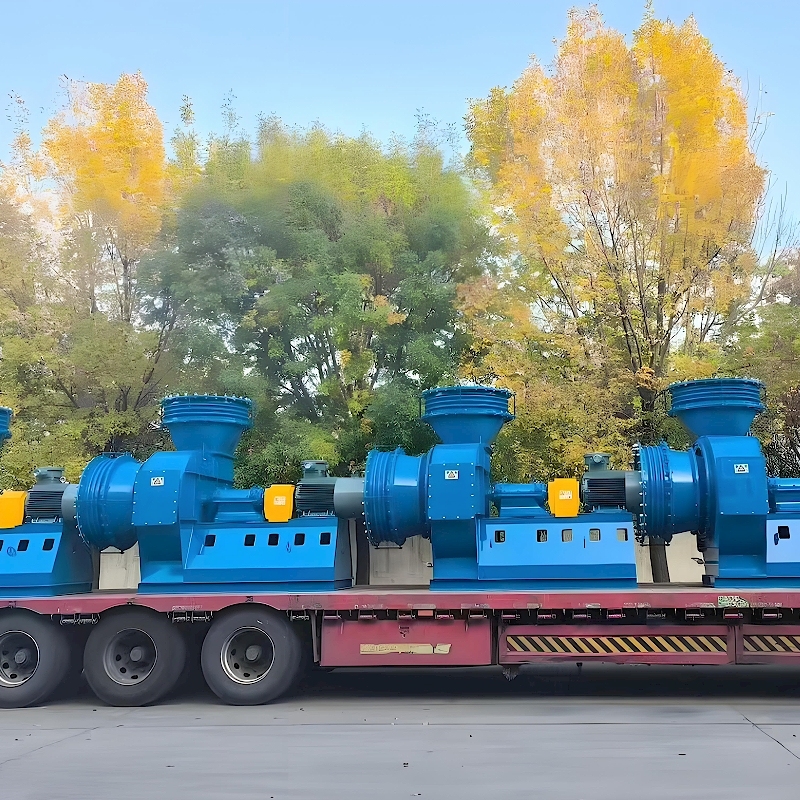
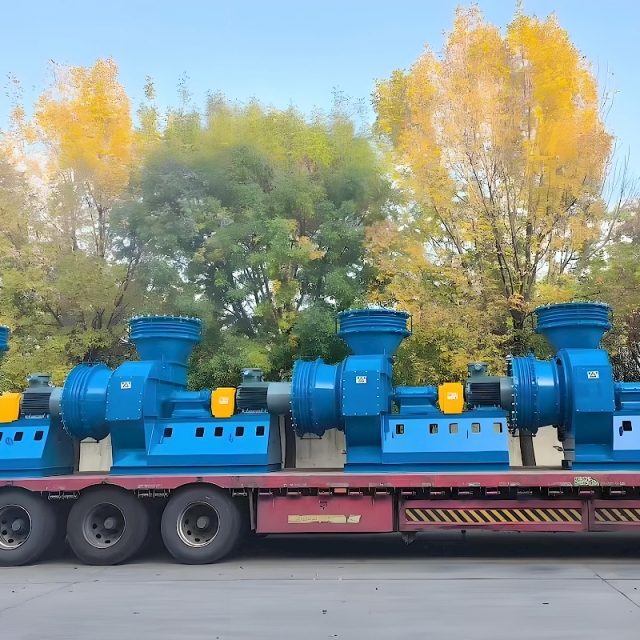
Product Introduction
Coke Dry Quenching (CDQ) Circulation Fan
In the Coke Dry Quenching (CDQ) process, the circulation fan is far from an ordinary industrial fan. It serves as the driving force for the entire inert gas circulation loop, re-pressurizing the cooled circulation gas—after it has exchanged heat within the boiler—and delivering it back into the quenching chamber. Here, the gas flows counter-current to the red-hot coke, facilitating a closed-loop cycle of heat absorption, heat exchange, and recirculation.
Should the circulation fan cease operation, the entire CDQ system is interrupted, rendering it impossible to achieve key process objectives such as cooling the red-hot coke, recovering steam, and improving coke quality. Consequently, from the initial selection phase through to daily operation, the primary requirement for a CDQ circulation fan is not the pursuit of extreme performance parameters, but rather engineering reliability under conditions characterized by high temperatures, heavy dust loads, and continuous operation.
Product Positioning: A Critical, Standalone Component
Unlike many industrial fan applications that incorporate redundant units, a CDQ circulation fan typically operates as a standalone piece of equipment with no backup. This operational characteristic dictates the design philosophy: all critical components—including the main shaft, bearings, impeller, and seals—must be engineered to support long-term, continuous operation.
The fan must operate reliably at inlet temperatures ranging from 150°C to 170°C, with a design capacity to withstand temperatures up to 250°C for short durations. Furthermore, the circulation gas carries coke dust that is both hard and highly abrasive, posing a constant challenge to the service life of all flow-path components. For these reasons, the technical threshold for a CDQ circulation fan is significantly higher than that of a conventional centrifugal fan; its design must simultaneously address the engineering challenges of high-temperature deformation, abrasive wear from dust, and the maintenance of a gas-tight seal.
Structural Design and Material Strategy: Engineered for Harsh Operating Conditions
In terms of structural configuration, CDQ circulation fans typically employ a double-supported, double-suction centrifugal design. The double-suction configuration allows gas to enter the impeller axially from both sides. This design reduces the required impeller diameter and rotational speed for a given airflow volume, which helps manage rotor dynamic loads. A dual-support arrangement ensures the rotor maintains structural rigidity and alignment stability, even at high speeds or under varying operating conditions. Hydrodynamic journal bearings are typically employed, supported by either self-lubricating water-cooled systems or forced-lubrication systems (via an external oil station). This ensures that the bearings retain basic cooling and load-bearing capabilities, even in the event of extreme malfunctions within the lubrication system.
Wear-resistant design is the critical factor determining the service life of the fan. Areas of the impeller prone to wear, as well as key sections of the volute casing, are typically reinforced with high-hardness, wear-resistant composite plates or imported high-strength wear-resistant liners. These materials feature a surface hardness of 59–62 HRC and a hard-phase content exceeding 50%.
Weld seams at the junctions between the blade trailing edges and the front/back shrouds are reinforced via hardfacing with wear-resistant welding electrodes to withstand continuous erosion from dust-laden gas streams. Furthermore, the fan casing utilizes a split-housing design, allowing the rotor to be removed for maintenance without the need to dismantle the inlet or outlet ductwork—significantly reducing downtime.
Gas-tightness is equally vital. Since the circulating gas is primarily inert, any leakage not only results in gas loss but also introduces potential safety hazards. Shaft seals typically employ a combination of nitrogen-purged barriers and carbon-ring seals. Casing joints are precision-machined and sealed with dual-layer PTFE gaskets to ensure airtight integrity, with all units undergoing rigorous leak testing prior to shipment. The rotor is balanced to a G2.5 grade (ISO 1940) to minimize vibration and residual unbalance.
Performance Range and Control Methods
Given the significant variations in the scale of dry quenching plants, the operating parameters for the circulating fans cover a correspondingly broad range. Typical industrial units feature an airflow capacity ranging from approximately 270,000 m³/h to 450,000 m³/h, with a pressure boost of 11,000 Pa to 12,100 Pa. They are designed for an operating temperature range of 150–170°C, with a maximum temperature tolerance of 250°C. For small- to medium-scale Coke Dry Quenching (CDQ) installations, the required airflow can be as low as 120,000–232,000 m³/h, with a total pressure of approximately 10–13.5 kPa. High-efficiency CDQ circulation fans can achieve an operating efficiency of up to 83.5%. Furthermore, they offer a broad high-efficiency operating range, allowing them to maintain superior performance even when operating conditions shift due to fluctuations in the volume of coke being discharged.
The method used to regulate airflow directly impacts operational economy. Traditional throttling via inlet dampers results in significant energy loss during partial-load operation; consequently, variable-frequency drive (VFD) speed control has become the preferred, mainstream solution. By adjusting the motor speed to match the airflow required for the actual coke discharge rate, operators can substantially reduce shaft power consumption during periods of lower load. Simultaneously, this enables more precise control over coke discharge temperatures and boiler inlet temperatures, contributing to the overall stable operation of the CDQ system.
Value within the CDQ Process
The engineering significance of a CDQ circulation fan is ultimately reflected in the economic benefits it enables for the entire system. The CDQ process recovers approximately 83% of the sensible heat from hot coke, which is then used to generate steam for power production. At the same time, it significantly reduces the water consumption required for quenching, as well as the discharge of pollutants such as phenols and cyanides.
As the primary equipment driving this heat-recovery loop, the operational stability of the circulation fan is directly linked to the sustained realization of energy-saving benefits. A well-designed fan—featuring appropriate material selection, robust sealing, and effective wear-resistance measures—maintains predictable performance degradation over a multi-year overhaul cycle. This minimizes production losses and restart costs associated with unplanned downtime, which is precisely why the CDQ circulation fan is considered a critical, single-point component within the steel and coking industries.