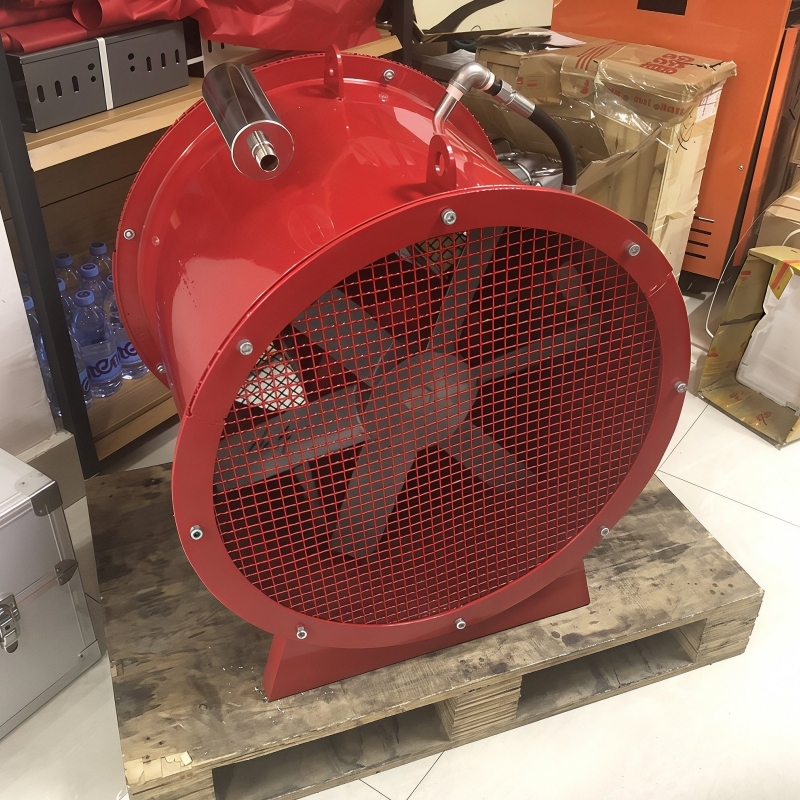
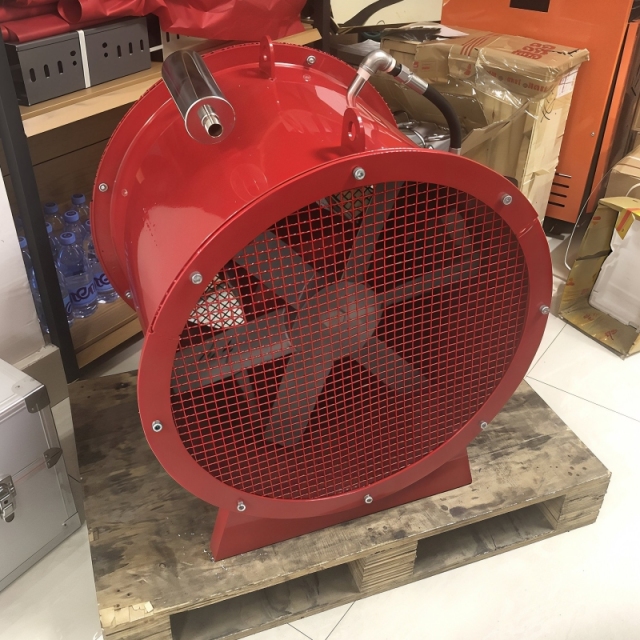
FQ Series Coal Mine Pneumatic Auxiliary Fan
In underground coal mines—specifically at excavation faces, the upper corners of coal faces, and various "dead zones" with poor ventilation—the localized accumulation of methane and other hazardous gases poses a critical challenge for safety management. While traditional electric auxiliary fans are widely used, they introduce the risk of sparks, necessitating additional protective measures in areas prone to high methane concentrations or outbursts.
The FQ Series Coal Mine Pneumatic Auxiliary Fan use relies exclusively on compressed air as a power source. By design, this eliminates the possibility of electrical ignition, offering an inherently safe technical solution for auxiliary ventilation.
Product Overview:
The FQ Series Coal Mine Pneumatic Auxiliary Fans—utilizes a pneumatic motor to drive an impeller. These units are manufactured in compliance with the *MT 500-2008 Technical Conditions for Pneumatic (Hydraulic) Auxiliary Fans for Coal Mines* and are designed and built to meet the requirements for explosion-proof equipment used in coal mines.
Primarily intended for forced (push-type) ventilation, the FQ Series Coal Mine Pneumatic Auxiliary Fan also be configured for exhaust-type ventilation depending on operational requirements. They are suitable for underground coal mine environments where the dispersal of methane and hazardous gases is necessary, particularly in poorly ventilated areas such as the upper corners of coal faces.
Product Specifications
| Impeller Diameter (mm) |
Air Volume (m³/min) |
Total Pressure (Pa) |
Gas Supply Pressure (Mpa) |
| 250 mm |
20 m³/min |
38 Pa |
0.3 MPa ~ 0.5 MPa |
| 355 mm |
28 m³/min |
30 Pa |
0.3 MPa ~ 0.5 MPa |
| 500 mm |
180 m³/min |
280 Pa |
0.3 MPa ~ 0.5 MPa |
| 560 mm |
200 m³/min |
350 Pa |
0.3 MPa ~ 0.5 MPa |
Operating Principle:
The FQ series features a straightforward and reliable power transmission system. Compressed air from the mine’s underground compressed-air pipeline is directed through a hose into the intake of the pneumatic motor housed within the fan casing. Once the valve is opened, the compressed air drives the pneumatic motor.
The pneumatic motor is enclosed within an explosion-proof chamber inside the fan casing. It transmits torque to the impeller, causing it to rotate at high speed. Airflow enters through a flow straightener and is accelerated by the rotating impeller; it then passes through rear guide vanes, which redirect the flow into a rotating jet as it exits the fan. This effectively disrupts and disperses accumulated methane and hazardous gases within the mine workings. The ingenuity of this design lies in the connection between the impeller and the pneumatic motor’s output shaft via a transmission assembly. The weight of the impeller is supported by this assembly rather than bearing directly on the pneumatic motor; this significantly reduces the load on the motor, effectively extending the service life of the entire unit.
Product Advantages:
The most prominent, differentiating feature of the FQ series is its intrinsic safety. The unit contains no electric motors, cables, or electrical control components. It generates no electrical sparks during operation and eliminates electrical risks such as motor short circuits, winding overheating, or the failure of explosion-proof enclosures.
The materials used for the impeller and its corresponding housing have been tested for friction-spark safety, further ensuring secure operation in environments where gas (methane) may be present.
Furthermore, pneumatic drive offers an often-overlooked protective benefit: superior overload protection. If the impeller becomes jammed or the load increases abnormally, the pneumatic motor will naturally shed the load as its rotational speed drops or it comes to a complete stop. This prevents the dangerous issues—such as intense friction, overheating due to a stalled rotor, or even mechanical damage—that could occur with an electric motor drive.
Applications:
The FQ series of pneumatic auxiliary fans for mining are primarily used for local ventilation in underground coal mines—specifically for dispersing and exhausting gas and hazardous vapors that accumulate in the "upper corner" (the corner area near the coal face).
Because airflow often struggles to reach the upper corner, it has historically been a challenging area for gas management. These pneumatic fans utilize a rotating jet stream to target and clear this zone—a method with a proven track record in actual coal mine operations.
Please note that the FQ series is designed for specific operating conditions: an altitude of no more than 2,000 meters, an ambient temperature between +4°C and +40°C, and a relative humidity of no more than 90% (at 25°C). Additionally, the installation site must be free from intense vibration and corrosive gases. If the intended operating environment falls outside these parameters, please consult with the manufacturer during the selection process to verify technical suitability. Selection and Installation Guidelines
During the selection phase, two primary factors must be verified: whether the required airflow volume is sufficient to dilute hazardous gases in the target area, and whether the on-site compressed air network can provide a pressure of at least 0.3 MPa with an adequate flow rate.
The available air supply must exceed the maximum air consumption of the pneumatic fan; otherwise, the fan will fail to achieve its rated performance specifications. Within the FQ№2.5 to FQ№5.6 model range, airflow capacity varies by a factor of ten. Therefore, simply choosing a larger model "to be on the safe side" is not advisable—excessive airflow in narrow tunnels can exacerbate dust dispersion or disrupt airflow patterns. It is more appropriate to select a model that aligns with the actual required airflow.
Regarding installation, the fan must be placed on a solid, level foundation and protected from direct sunlight or rain. To ensure unobstructed air intake, a clearance of at least 0.3 meters must be maintained between the intake edge and the floor or roof. Before initial operation, verify the integrity of the seal between the pneumatic motor’s air inlet and the compressed air supply line. During operation, the fan’s output can be continuously adjusted by regulating the air supply via the upstream compressed air valve.
Routine maintenance focuses primarily on air filtration and the lubrication status of the pneumatic motor. Compared to the explosion-proof electrical inspections required for electric auxiliary ventilation fans, the scope of maintenance here is more focused, and the technical requirements are more straightforward.