Product Introduction
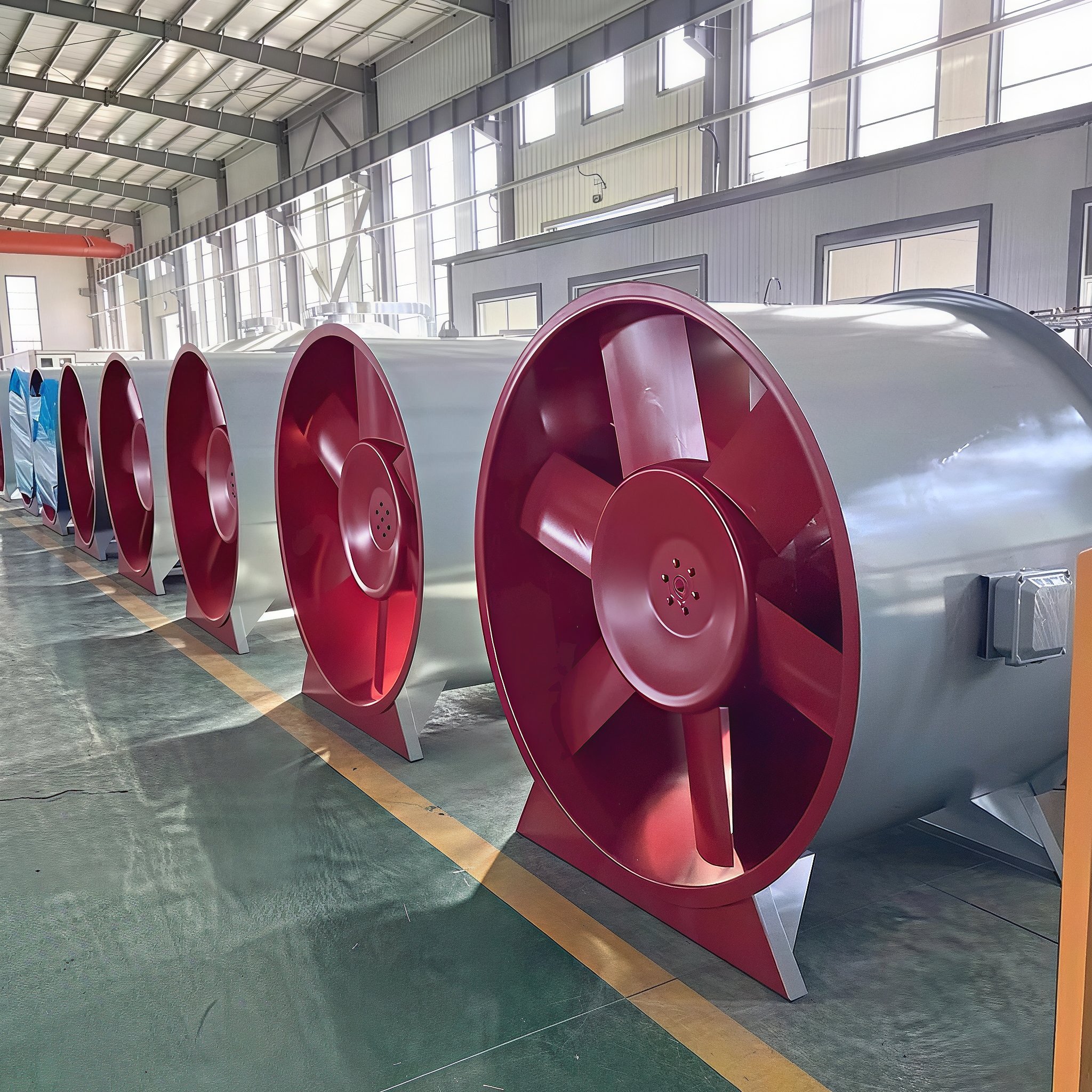
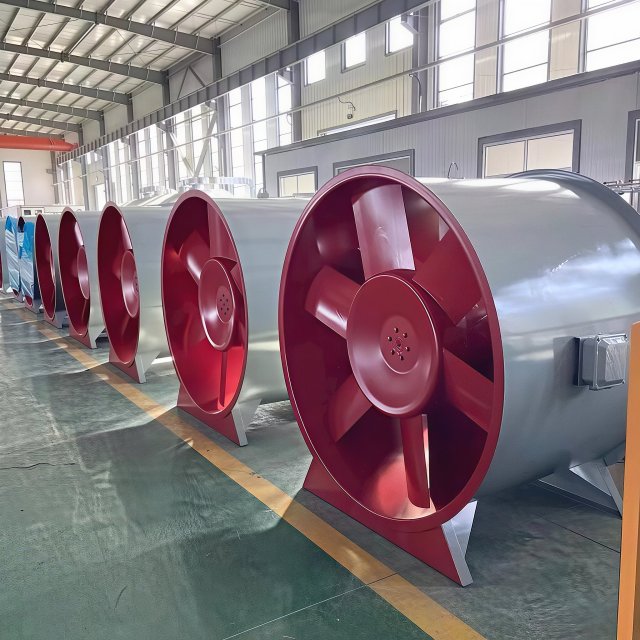
T Series Axial Fan
In ventilation systems for factory workshops, tunnels, utility galleries, cooling towers, or livestock and poultry facilities, axial-flow fans perform the fundamental yet critical task of delivering the required volume of air to its intended destination. The T-series axial-flow fan line is designed specifically for this purpose; as a quintessential example, it has long stood as the most widely used and versatile category of axial-flow fans in industrial ventilation.
T35/T40 Series: Balancing Efficiency, Noise, and Cost
The T35-11 series is an evolved platform based on the earlier T30-11 axial-flow fan design. Key improvements include: transitioning to a cylindrical hub structure to reduce flow losses, while simultaneously strengthening the blade roots; increasing total pressure efficiency to 89.5%; and lowering noise levels (specific A-weighted sound level) by 3.6 dB(A) compared to the previous generation. Consequently, the T35/T40 series offers a more optimized balance of energy consumption, noise, and cost for applications requiring high airflow at low-to-medium pressure.
This series is designed for non-flammable, non-explosive, and non-corrosive gases, with an operating ambient temperature typically not exceeding 60°C. Within these parameters, it is well-suited for ventilation, air exchange, or heating/cooling distribution in factories, warehouses, offices, and residential buildings. It can also serve as an in-line booster for extended exhaust ductwork, or—with the casing removed—operate as a free-standing fan. For the vast majority of standard industrial and civil ventilation requirements, the T35/T40 series provides a practical, "right-sized" solution without the need for over-engineering.
Model Range and Selection Logic: Determining Airflow and Pressure, Then Selecting Size and Blade Angle
The T35-11 series encompasses model sizes ranging from 2.8 to 11.2, providing a comprehensive, graduated spectrum of impeller diameters. Each unit size comes standard with four blades, with an adjustable installation angle ranging from 15° to 35° (in 5° increments). Across the entire series, the airflow capacity spans approximately 826 to 67,892 m³/h, with a total pressure range of 39 to 474 Pa, and compatible motor power ratings from 0.12 kW to 7.5 kW. For any given unit size, varying the blade angle and rotational speed yields different combinations of airflow, pressure, and power consumption—a flexibility that allows the T series to cover a wide range of operating conditions with a limited number of unit sizes.
When selecting a model, the most practical approach is to first determine the required airflow and total pressure for the system, then consult the performance tables to identify the appropriate unit size, blade angle, and rotational speed, and finally verify the motor power and installation dimensions. Relying solely on duct diameter or a specific unit size designation can often lead to insufficient airflow or motor overload if system resistance changes. In international trade, if a buyer provides specific operating parameters, the supplier’s assistance in matching the equipment to these requirements serves as a valuable technical service—a capability worth highlighting in product documentation.
Expanding the T Series: From General Ventilation to Anti-Corrosion and Explosion-Proof Applications
While the base T35/T40 models are designed for standard gas transport, industrial environments often involve gases that are corrosive or explosive. To address this, the platform offers two key variants: the FT35-11, constructed with fiberglass-reinforced plastic (FRP) and specialized anti-corrosion motors for corrosive environments; and the BT35-11, which features an aluminum alloy impeller paired with an explosion-proof motor—designed to prevent sparking during operation—making it suitable for environments with flammable or explosive gases. Both variants share the same performance parameters and physical dimensions as the standard T35-11 model. This ensures that if a project’s requirements evolve from standard conditions to those necessitating anti-corrosion or explosion-proof capabilities, the existing system interfaces and installation logic can remain unchanged, thereby reducing retrofit costs. In practical applications, this versatility allows the T-series to extend its reach far beyond general factory floor or warehouse ventilation. It encompasses specialized use cases such as transformer cooling and electrical room ventilation in the power sector; the extraction of corrosive gases in chemical processing and electroplating facilities; explosion-proof ventilation for oil and gas sites or paint-spraying workshops; as well as auxiliary ventilation for cooling towers and air circulation in drying rooms. For an independent e-commerce website targeting international markets, clearly outlining the selection path—categorized into "standard," "corrosion-resistant," and "explosion-proof" models—is far more effective in helping overseas buyers identify the right product than simply listing various industries.
Export Compliance and Energy Efficiency: Key Considerations for CE, IE3, and ErP Standards
When exporting to the European Union or other markets that adhere to international standards, compliance for T-series axial-flow fans must be addressed at two distinct levels. At the motor level, EU Regulation 2019/1781 mandates that three-phase motors ranging from 0.75 kW to 1000 kW must meet the IE3 efficiency class (with the 75–200 kW range requiring the even higher IE4 standard as of July 2023). At the complete fan unit level, EU Regulation 327/2011 imposes separate energy efficiency requirements for fan systems (comprising the motor, impeller, and controls) with power ratings between 125 W and 500 kW. These two requirements are not interchangeable—a compliant motor does not automatically ensure a compliant complete unit—a nuance frequently overlooked when preparing export quotations and technical documentation.
Regarding performance certification, many international axial-flow fan product lines undergo airflow-pressure testing in accordance with ISO 5801 or AMCA 210, often securing AMCA certification for sound and air performance. For product pages on an independent website, if the target market demands high credibility regarding performance data, explicitly stating the testing standards used and the types of available certification documents will be far more persuasive than a generic claim of being "highly efficient." Practical Parameters for Installation and Long-Term Operation
The T-series axial-flow fans offer flexible installation options: they can be integrated into ductwork to boost pressure, mounted in a fixed position, or used as free-standing fans (with the casing removed). During hoisting, ensure that lifting ropes are not secured to the rotor or the casing. The base must be leveled and seated naturally against the foundation; avoid using bolts to force a fit, as this can cause the casing to deform. Bearing lubrication is the most critical factor for long-term operation: under standard conditions, grease should be replenished every three to six months—though this interval should be adjusted based on actual operating hours and environmental conditions. For sealed bearings, replacement should be considered after a specific number of cumulative operating hours. Including these maintenance guidelines in product documentation helps reduce premature failures caused by improper installation or upkeep, while also demonstrating the supplier’s deep application expertise.
Why the T-Series Should Be a Core Product Line for Your Export-Focused Website
From a procurement perspective, the strength of the T-series axial-flow fans lies not in any single extreme performance metric, but in their versatility across various operating conditions, their scalability through design variants, and their favorable total life-cycle cost. A single platform can address diverse requirements—ranging from general ventilation and anti-corrosive exhaust to explosion-proof air exchange. The combination of various frame sizes and adjustable blade angles provides extensive configuration flexibility, while a mature production system ensures reliable lead times and consistent spare-parts availability. For websites targeting overseas engineering firms, original equipment manufacturers (OEMs), and MRO (maintenance, repair, and operations) buyers, positioning the T35/T40 series as a "go-to solution for industrial ventilation"—supported by clear selection guides and compliance information—is more effective for generating consistent inquiries than focusing solely on a single "high-performance" specification. For specific applications, clients can simply provide details such as required airflow, total pressure, the nature of the medium (gas/air), and power supply specifications, allowing our technical team to determine the optimal model, blade angle, and motor configuration.