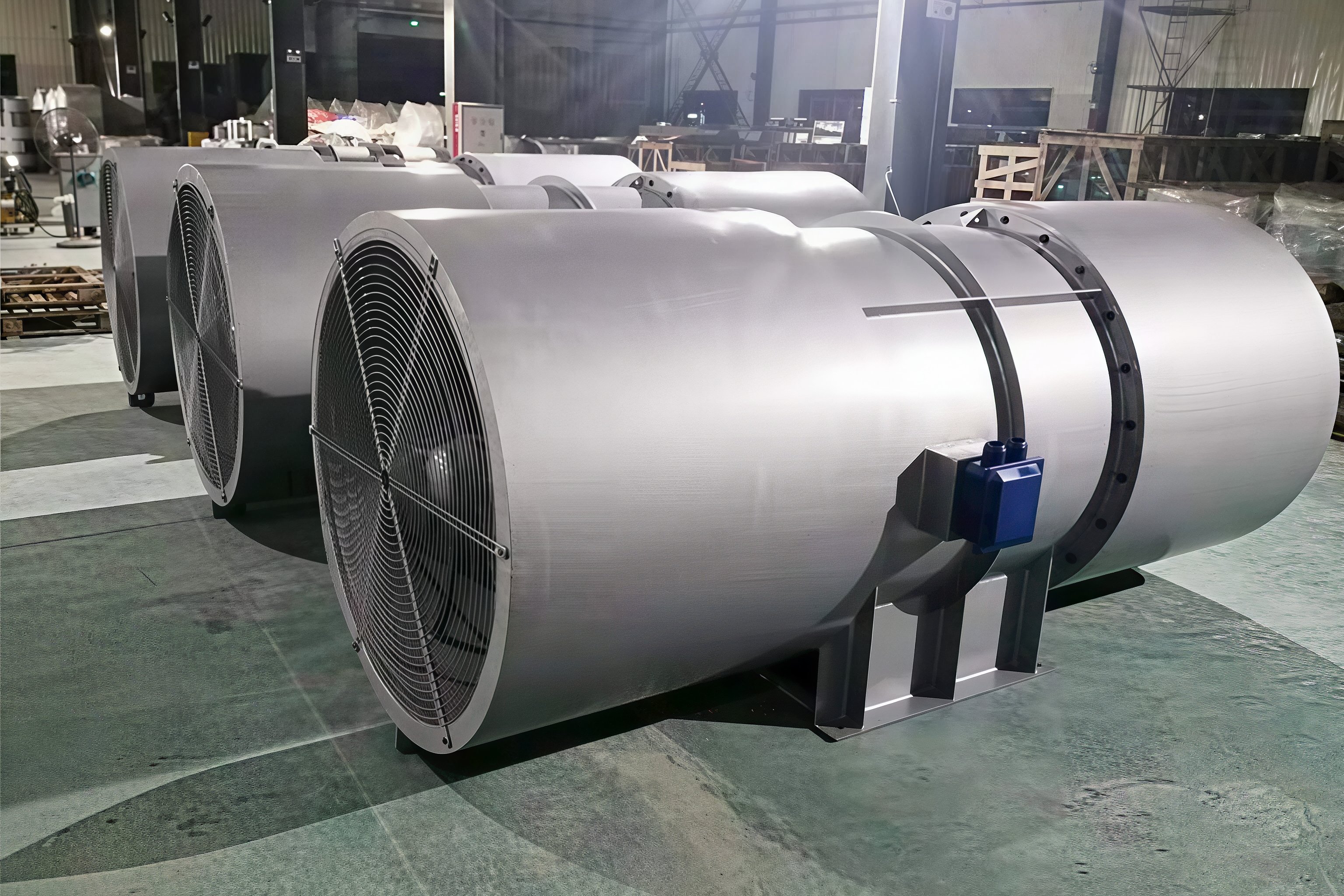
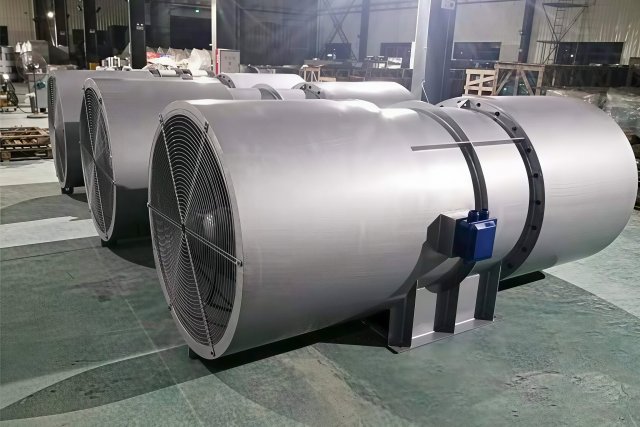
Unidirectional Tunnel Jet Fans
High-Efficiency Longitudinal Ventilation · High Thrust · Low Noise · Designed Specifically for Road and Railway
Tunnels
Unidirectional
tunnel jet fans are core components of longitudinal ventilation systems for road tunnels, railway tunnels, and underground infrastructure. Suspended from the tunnel ceiling or sidewalls, these fans discharge high-velocity air jets that drive the overall axial movement of air within the tunnel. This facilitates routine ventilation, the dilution of pollutants, and smoke control during fire emergencies. This series of unidirectional jet fans encompasses a full range of impeller diameters—from 630 mm to 1600 mm—with a maximum thrust of up to 3500 N per unit and an airflow capacity ranging from 8 to 54 m³/s, effectively meeting the ventilation requirements for tunnels of varying lengths and operational loads.
Product Overview
As a category of axial-flow fans, unidirectional jet fans—alongside reversible (bidirectional) jet fans—represent the two primary types of jet ventilation used in tunnels. Their design objective is to generate a highly concentrated, directional jet stream while minimizing energy consumption and space requirements. Through the entrainment effect, this jet stream induces the directional movement of a large volume of air across the tunnel cross-section. Compared to conventional axial-flow fans, these jet fans feature specialized aerodynamic optimization; they typically achieve outlet velocities between 19 and 42 m/s. This results in slower jet decay and a longer effective reach, offering significantly higher efficiency in moving air over long distances for a given power input.
The impellers in this series utilize adjustable, airfoil-shaped blades. By modifying the number of blades and their pitch angles, the airflow and thrust can be precisely tuned across a wide range. This allows the system to adapt to varying tunnel resistance characteristics and ventilation loads without the need to replace the entire unit. The casing and silencer sections are manufactured using CNC spinning and robotic welding processes, ensuring high coaxial precision and tight control over the radial clearance between the impeller and the casing—providing a robust structural foundation for long-term, stable operation.
Key Advantages
High thrust density, saving installation space. With a per-unit thrust capacity of up to 3500 N, these fans allow for a reduction in the total number of units or lower power ratings for individual fans while meeting the same ventilation requirements. This helps minimize the vertical space occupied by equipment near the tunnel ceiling and reduces the space that must be allocated during civil engineering design.
Optimized aerodynamic efficiency. Developed using 3D design theory and CFD (Computational Fluid Dynamics) flow field simulation, the impeller and the inlet/outlet flow paths have been precisely tuned. This results in superior performance and operational stability compared to conventional products of the same specifications, ultimately lowering the long-term energy consumption of the tunnel ventilation system.
Broad operational flexibility. By adjusting the number of blades and their pitch angles, airflow and thrust can be flexibly matched to specific design requirements. This ensures that an efficient, low-noise operating point can be selected for any load or condition, preventing the energy waste often associated with "oversized" equipment (i.e., using equipment with a capacity far exceeding the actual demand).
Environmental adaptability. The units are equipped with totally enclosed, squirrel-cage motors (IP55 protection rating, Class H insulation). Both the interior and exterior of the fan assembly are treated with anti-corrosion coatings, ensuring durability against the high humidity, corrosive gases, and dust typically found in tunnels. For noise-sensitive environments, inlet and outlet silencers can be added to further reduce operational noise.
Fire-related smoke extraction. While primarily designed for routine longitudinal ventilation, these unidirectional jet fans can also function as part of a ventilation system to direct and exhaust smoke during a fire. Specific models can meet certification requirements for high-temperature smoke extraction—withstanding 300°C for 2 hours or 400°C for 2 hours—providing a reliable equipment-level solution for tunnel fire safety systems.
Technical Specifications Summary
The primary technical range for this series of unidirectional jet fans is outlined below (specific model parameters vary based on impeller diameter, rotational speed, blade configuration, and motor power; final selection should be verified through calculations based on specific tunnel parameters):
Available impeller diameters include 630 mm, 710 mm, 800 mm, 1000 mm, 1120 mm, 1250 mm, 1400 mm, and 1600 mm. The airflow capacity ranges from 8 to 54 m³/s (approximately 28,800–194,400 m³/h), with larger-diameter, high-speed models covering the upper end of this range. The total pressure capacity spans approximately 1,900 to 6,400 Pa, determined based on specific airflow and thrust requirements. Motor power ratings range from 6 to 84 kW, with common configurations including 7.5 kW, 11 kW, 15 kW, 22 kW, and 30 kW. Outlet velocities typically fall between 19 and 42 m/s, characteristic of the high-speed jet flow produced by tunnel jet fans. Noise levels vary by model and the inclusion of silencers; base models typically range from 50 to 68 dB(A), with further reductions possible when silencer sections are added. The motors feature an IP55 protection rating and Class H insulation, ensuring suitability for long-term operation in tunnel environments. Anti-corrosion treatment involves coating the entire unit (both internally and externally), with materials for the casing and impeller selected based on the specific corrosion-resistance requirements.
The parameters above serve as a general reference range; the actual equipment supplied will be defined by the technical documentation for the specific model selected.
Operating Principle
Unidirectional jet fans are suspended from the tunnel ceiling or side walls. Rather than relying on extensive ductwork, they discharge a high-speed airstream directly along the tunnel axis. Upon exiting the fan, the high-speed jet entrains and accelerates the surrounding stationary air through momentum exchange within the turbulent boundary layer, creating a longitudinal airflow throughout the tunnel. When multiple fans are arranged in series along the tunnel, their combined thrust overcomes resistance—including friction, local resistance, and the "piston effect" caused by moving traffic—to maintain the required fresh air volume and ensure the effective dilution of pollutants. This method of "longitudinal ventilation driven by jet thrust" eliminates the need for large-scale ductwork throughout the tunnel, resulting in high utilization of the civil engineering cross-section and simplified installation. It is particularly well-suited for the ventilation requirements of short-to-medium-length highway tunnels and underground parking facilities.
Application Scenarios
Highway tunnels. Unidirectional jet fans are the primary equipment used for longitudinal ventilation in highway tunnels during their operational phase. They serve to dilute CO, NOₓ, particulate matter, and smoke, thereby ensuring adequate visibility for drivers and maintaining air quality. For short highway tunnels (under 1 km), jet fans are an ideal choice: their compact design allows for ceiling suspension without the need for pre-installed air ducts, and they generate sufficient thrust to achieve effective longitudinal ventilation—all while keeping civil engineering costs and construction complexity low.
Railway and metro tunnels. In railway and metro tunnels, jet fans handle routine air exchange and provide smoke control during emergency scenarios. Given the space constraints and the significant "piston effect" (air movement caused by moving trains) in metro tunnels, the compact structure and flexible positioning of jet fans make them a standard solution for longitudinal ventilation.
Underground parking garages and auxiliary passages. Beyond traffic tunnels, jet fans are also suitable for other enclosed or semi-enclosed spaces—such as underground parking facilities, auxiliary tunnels, and grit chambers—where directional airflow is required.
Auxiliary ventilation in extra-long tunnels. For extra-long tunnels (exceeding 3 km) or applications requiring high-volume, long-distance air delivery, axial-flow fans paired with air ducts typically serve as the primary ventilation system. In these cases, jet fans are used as auxiliary equipment to facilitate zonal airflow, provide localized make-up air, or manage smoke during fire incidents.
Selection and Installation Considerations
The selection of jet fans is primarily based on the interplay between tunnel length, the chosen ventilation strategy, and available installation space. Longitudinal ventilation using jet fans is the preferred approach for short tunnels and underground parking garages. For long highway or metro tunnels, the spacing, quantity, and required thrust of the jet fans must be determined through ventilation network calculations. These calculations account for factors such as the tunnel's cross-sectional area, friction resistance coefficients, traffic volume, and the volume of smoke generated in the event of a fire.
Jet fans are typically installed via ceiling suspension or wall-mounted brackets. They are arranged in series along the longitudinal axis of the tunnel at specific intervals, though multiple units may also be installed in parallel near the tunnel entrance. Vibration-damping devices, safety anchors, duct connections, and electrical wiring for the fans must comply with relevant tunnel standards regarding waterproofing, corrosion resistance, and fire-safety power supply. For noise-sensitive sections, silencer requirements should be specified during the selection phase to avoid the costs of subsequent noise-mitigation retrofits.
Quality and Certification
These products are designed and manufactured in accordance with technical specifications for tunnel jet fans. They feature Class H motor insulation and an IP55 ingress protection rating, with an anti-corrosion coating applied to the entire unit to enhance durability in tunnel environments. For models intended for fire-related smoke extraction, certifications for high-temperature performance can be provided based on project requirements; the necessary temperature resistance rating and duration should be determined in alignment with the tunnel’s fire-safety design standards. Every fan undergoes performance testing and operational checks prior to dispatch to ensure that airflow, total pressure, thrust, and vibration/noise levels meet the requirements specified in the technical documentation.
Frequently Asked Questions
Q: How should one choose between unidirectional and reversible jet fans?
A: For tunnels where the primary need is routine operational ventilation and the direction of smoke extraction during a fire is fixed, unidirectional jet fans are preferred, as they offer superior aerodynamic efficiency and thrust output for a given size. For tunnels that require bidirectional smoke extraction or where the ventilation direction may need to be reversed based on operational conditions, reversible (bidirectional) jet fans should be selected.
Q: Is higher thrust always better for a jet fan?
A: Thrust must be precisely matched to the tunnel's resistance. Excessive thrust not only leads to unnecessary capital expenditure and higher energy consumption but can also result in excessive air velocity, increased noise, and the re-suspension of dust within the tunnel. Selection should be based on ventilation network calculations, ensuring the chosen model provides appropriate thrust and operates at a high-efficiency point while meeting the required design airflow.
Q: Can jet fans be used for smoke extraction during a fire?
A: Unidirectional jet fans can assist in directing and exhausting smoke during a fire; however, it is essential to verify that the specific model’s temperature resistance rating complies with the temperature-versus-time curve mandated by the project’s fire-safety design. For projects with specific certification requirements for fire-related smoke extraction, the corresponding certification criteria must be specified during the equipment selection process.
Get Selection Support
The final specifications for unidirectional tunnel jet fans depend on a variety of parameters, including tunnel cross-section, length, traffic characteristics, ventilation standards, and fire safety requirements. If you require thrust calculations and model matching for a specific project, or need product documentation—such as details on impeller diameters, power configurations, and certification compliance—please contact us and provide the basic tunnel parameters. Our technical team will offer selection recommendations and assist with drawing verification.